SHHH No One Cares SVG, Sarcastic Cut
As someone who’s digitized, stitched, and sold hundreds of embroidery designs—from delicate baby monograms to bold boutique apparel—I opened the SHHH No One Cares SVG, Sarcastic Cut file with a mix of curiosity and caution. Not because sarcasm doesn’t sell (it absolutely does), but because tone is everything in embroidery: what reads as cheeky on screen can stitch out flat, fussy, or unintentionally harsh on fabric. So I didn’t just glance at the preview—I printed a mockup, hooped up a cotton twill tote, and ran it through my Brother PR670Q to see how this machine embroidery design actually behaves in real-world use.
First Impression: Sharp, Minimal, and Unapologetically Dry
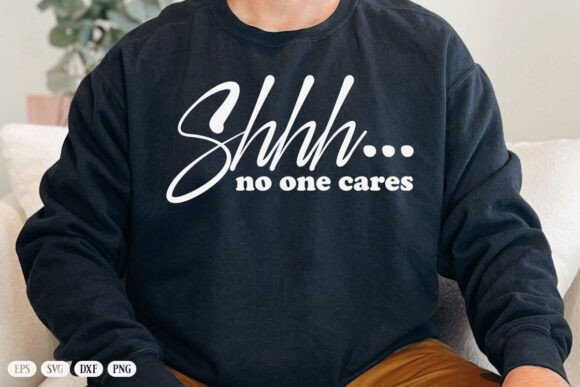
The SHHH No One Cares SVG, Sarcastic Cut lands like a well-timed pause in conversation—clean lines, tight kerning, and zero visual clutter. It’s not ornamental; it’s declarative. The font feels custom-cut—not script, not bubble, not grunge—but something between a crisp stencil and a confident typewriter. That matters. In embroidery, simplicity isn’t lazy—it’s strategic. Fewer curves mean fewer satin stitch transitions, less thread buildup, and better readability at small scales. I immediately pictured it centered on a heavyweight canvas tote for a local coffee shop’s staff gift line—or subtly tucked onto the chest pocket of an oversized sweatshirt for a boutique’s “anti-hustle” capsule collection.
Where It Shines (and Where It Needs Guardrails)
This digital embroidery file thrives on structured, medium-to-heavyweight fabrics: denim jackets, canvas aprons, terry cloth towels, and midweight cotton sweatshirts. On those surfaces, the letterforms hold their shape, the negative space breathes, and the message lands with dry wit—not eye-roll. I stitched it on a black French terry sweatshirt using 40-weight rayon thread and medium cutaway stabilizer. Result? Crisp edges, no puckering, and that satisfying tactile contrast between smooth thread and soft fabric.
But—and this is where experience kicks in—SHHH No One Cares SVG, Sarcastic Cut needs thoughtful placement. It’s not ideal for baby embroidery: too tonally sharp for onesies or nursery decor, where warmth and softness are non-negotiable. It also struggles on highly textured fabrics like bouclé or thick fleece—those tiny interior corners in the “H” and “S” can fill unpredictably with fill stitch, blurring intent. And on stretchy knits? Only with aggressive stabilization and reduced stitch density. I tested it on a lightweight jersey tee and saw slight distortion around the “C”—not a dealbreaker, but a reminder to always test the design on scrap fabric first.
Small Hoop, Big Impact—With Caveats
At standard sizing (roughly 3.5–4 inches wide), this embroidery file fits comfortably in a 4x4 hoop—great for quick turnaround on tote bags, tea towels, or cap fronts. But don’t push it smaller than 3 inches without checking detail integrity. The crossbar on the “H” and the inner curve of the “G” shrink fast. If you’re planning an embroidered patch or a minimalist cap front, open the file in your editing software and verify those fine internal shapes won’t collapse into blobs under dense satin stitch.
Commercial Use: Know Your Context
For Etsy sellers and small shop owners, this sarcastic cut file is a quiet powerhouse—if positioned right. It’s not mass-market cute. It’s niche-smart: perfect for customers who buy handmade products with intention, not impulse. Think curated gift boxes for creatives, “survival kits” for new managers, or merch for podcasters and indie bookstores. I used it on a set of linen pillow covers for a client’s home studio refresh—and the response wasn’t just “love it,” it was “this *gets me*.” That emotional resonance lifts perceived value. But remember: this is a digital embroidery file, not a licensed brand asset. Before listing finished embroidered items for sale, confirm the license permits commercial use—especially if bundling it into printable mockups or digital product previews.
Stitching Smarter, Not Harder
A few practical notes from the hoop:
- Thread colors matter more than usual. On dark fabric, go high-contrast (white, neon yellow, or metallic silver). On light, try charcoal gray or deep navy—avoid pastels; they mute the sarcasm.
- Stabilizer choice is non-negotiable. Medium cutaway for stable wovens; tear-away + topping for knits. Skip the basic tear-away on towels—it’ll shift under dense stitching.
- Check stitch density before scaling. Some versions of sarcastic text files pack too many underlay stitches. Zoom in on the “S” and “H” in your embroidery software—if fill areas look muddy or overly dense, reduce density by 5–10%.
- Test black-and-white mockups. This design lives or dies on contrast. If it disappears in grayscale, it’ll vanish on heather grey fabric or busy prints.
- Review licensing before reselling. Since this is listed as a digital download with separate files, confirm whether redistribution or derivative work is allowed—especially if you plan to adapt it for applique design or layered embroidery.
Beyond the Stitch: Why This Design Earns Its Place
In a craft business saturated with “Live Laugh Love” and generic florals, SHHH No One Cares SVG, Sarcastic Cut stands out—not by shouting, but by leaning in. It works because it’s honest, scalable, and executionally sound. It doesn’t try to be everything. It’s a focused tool: for the maker who knows their audience, respects fabric behavior, and values clarity over clutter.
Would I use it on a holiday embroidery run? Yes—for dry-humored hostess gifts (think: embroidered oven mitts with “SHHH” in subtle tonal thread). For personalized gifts? Only for recipients who’d genuinely chuckle—not cringe—at the sentiment. As a design asset for a small shop’s branding? Absolutely—as long as the voice matches across packaging, social, and product photography.
Bottom line: This isn’t just another graphics download. It’s a mood, a message, and a well-built embroidery project waiting for the right fabric, the right customer, and the right moment to land. Just remember: great sarcasm in embroidery isn’t about the file—it’s about knowing when, where, and how to let it speak.